
Travelling through mainland Greece and the Peloponnesian Peninsula makes for a memorable trip
BY BRINDA GILL | PHOTOGRAPHS: SATYAJIT S. GILL
We are all Greeks. Our laws, our literature, our religion, our arts have their root in Greece,” stated poet PB Shelley in the preface of Hellas, the lyrical drama he penned in 1822 in empathy for the cause of the Greek War of Independence. His sentiments allude to his appreciation of Greece being the cradle of European civilisation; a fountainhead of architecture and arts, philosophy and medicine, poetry and literature, athletics and theatre; the birthplace of democracy and much more!
As the aura of ancient Greece – of being a source of different facets of culture that made their way to different countries over millennia – endures to this day, it was on our must-visit list. And to fulfil the wish to explore and experience the marvels of ancient Greece along with its contemporary culture we signed up for a tour through a part of mainland Greece and the Peloponnesian Peninsula, the southernmost part of the mainland.
We opted for this tour as the itinerary spanned towns and cities that traced their origins to ancient times, important archaeological sites and places that offered an insight into local culture, and local experiences. In addition, were specialists to guide us through archaeological sites and museums.
We flew to Athens, took a comfortable and convenient bus ride from the airport to Syntagma Square (the city centre) and walked across to Royal Olympic Hotel. A little later we stepped out for a light refreshment at a café closeby and to orient ourselves to the heart of the city. We walked a few streets glimpsing the Arch of Hadrian, and then caught an iconic view the Acropolis (a UNESCO World Heritage Site) with the Parthenon.
We walked on along a street by the base of the Acropolis taking in views of the rugged walls of the citadel; then through Plaka – “The neighbourhood of the Gods,” a bustling area with stores and cafés; and Anafiotika, a quiet charming residential neighbourhood. There were many attractive stores through the walk such as Pistachio Land, a store with products only of pistachios; Mystic Sweets, with trays displaying a variety of sweet treats; and Roka with displays of lovely tapestries by handwoven by Rita. Back at the hotel, we had dinner at the rooftop savouring a delicious meal – of Greek salad, Aubergines Imam and Black Linguine with beverages – and a spectacular view of the beautifully-lit Acropolis watching over the city.
Next morning breakfast was served at the rooftop restaurant and we enjoyed expansive views – of the Acropolis, Hadrian’s Arch, Mount Lycabettus and the city by day over an elaborate and leisurely breakfast. Well rested and nourished we stepped out walking to Benaki Museum stopping at the historic marble Panathenaic Stadium (where the Athens Olympics, the first international Olympics in modern history were held in 1896); the National Garden, a quiet and green retreat; and the stately Presidential Mansion where we watched the Changing of the Guard ceremony.
We were soon at the Benaki Museum where a couple of hours passed by fast admiring the collections of antiquities, art and textiles showcasing the rich heritage of Greece. From the museum, we walked to the Greek Parliament, especially famous for the Changing of the Guard ceremony that takes place at the Tomb of the Unknown Soldier. Then passing the famous Hotel Grande Bretagne and Syntagma Square, we headed for Brettos (founded in 1909, it is the oldest distillery in Athens) to enjoy a tasting of ouzo (aperitif) and masticha (Greek liqueur) followed by lunch (horiatiki – Greek salad full of freshness prepared with tomatoes, cucumbers, black olives and feta, along with moussaka, an all-time favourite). In the evening we moved to Divani Palace Acropolis and met our tour group over dinner.
Next morning was cloudy and breezy as we headed to the Acropolis. Soaking in the soft drizzle, treading the marble steps and uneven ground carefully, we stepped in through the monumental Propylaea and explored the hallowed site – taking in the narratives of the site that has a history spanning millennia and its structures (many of which date to about the 5th century BC).
We soaked in the grandeur of the Parthenon, the charm of the Temple of Athena Polias (with its graceful sculpted female figures that function as columns), the remains of once imposing structures and the expanse of the theatre, before heading for the Acropolis Museum filled with impressive architectural elements, statues and artefacts that brought ancient Greece alive. The two sites conveyed how the distinct orders of columns (Doric, Ionic and Corinthian), triangular pediments and sculpted statues were inextricably associated with Greek architecture.
Afternoon was spent enjoying a delicious light lunch (salad, spinach pie and beverage) and a drive through the city centre with its varied sights including Dromeas (The Runner) an artistic sculpture created with thousands of pieces of glass, bringing to mind the story of the iconic run Pheidippides (who ran from Athens to Sparta a distance of 240 kilometres at the time of the Battle of Marathon in 490 BC); Athens University Buildings; and a stop at Panathenaic Stadium and its souvenir store.
The next morning post-breakfast (an elaborate affair with Greek and international dishes) it was time to head to head west. The first stop was at the awe-inspiring and scenic Corinth Canal (a 6.4 kilometres long, 24.6 metres wide man-made canal, cut into the isthmus, to connect the Ionian Sea with the Aegean Sea thus facilitating trade and travel, opened in 1893) and then the bus crossed over to the Peloponnese Peninsula.
We soon stopped to explore ancient Corinth once a hub of commerce, trade, culture and religion (and associated with Corinthian architectural columns) and the interesting on-site Archaeological Museum of Ancient Corinth where the finds from the Sanctuary of Asklepios (the ancient Greek God of healing whose symbol was a serpent wrapped around a staff that endures as the symbol of medicine even today!) were particularly fascinating.
The drive then continued offering expansive views of the Aegean Sea; at one area large colourful circular fish farms dotted the waters near the shore. Post a stop for lunch at a lovely al-fresco restaurant, with its ceiling filled with lush vines, the tour headed for Epidaurus (a UNESCO World Heritage Site), exploring the Sanctuary of Asklepios (6th century BC), a health sanctuary of ancient Greece (including bathhouses), where healing encompassed observation/evidence of symptoms of patients and rituals (not only faith-based healing) as well a spectacular amphitheatre (as it was believed that watching performances was therapeutic) with incredible acoustics.
The drive then carried on to Nafplio, lovely seaside port city, the first capital (1823- 1834 AD) of modern Greece. We walked the base of its hillside fort, the charming precinct along the coast with lovely stores and cafes and the seaside taking in views of the waters and castle with a stop for delicious gelato. The night halt was at Amalia Hotel Nafplio where fortuitously a group of ebullient music lovers from Cyprus were staying at the hotel, and as we relaxed in the hotel lounge we were happily privy to one of them playing the piano and others singing.
The following day brought in more interesting sights as we journeyed to the ancient archaeological site of Mycenae (a UNESCO World Heritage Site) where we explored the beehive-shaped royal tombs, the large Treasury of Atreus being the most impressive, the Lion Gate and the remains of the palace marvelling at the massive cyclopean walls. Next on the itinerary was a pottery centre at Fycthia where skilled potter Anastasia Maragos gave us a quick introduction to the tradition of Mycenaean pottery, and we purchased a Pythagoras cup – so crafted that when filled beyond a specific level the entire contents drain out! It was traditionally used to observe qualities of contentment or greed in people.
Dinner was at Magna Grecia, the olive and wine farm of the Karabelas family who shared a short presentation about production of olive oil and served us a wonderful meal with Greek wines along with Greek music and dancing. The night halt was Amalia Hotel Olympia with the weather witnessing a drop in temperature as a dust storm originating in Sahara Desert made the conditions very windy and the air tinged with orange dust.
Next morning, the destination was Olympia (a UNESCO World Heritage Site) – the legendary site of the Olympics in 776 BC! We savoured the iconic site taking in remains of temples, the site where the flame lighting ceremony of the modern Olympics takes place and then the ancient Olympic stadium. This was followed by a visit to the Archaeological Museum of Olympia filled with antiquities of which the helmet of Miltiades, who fought the historic Battle of Marathon, was very special.
Post lunch at Ambrosia restaurant near the archaeological site, the bus set off towards Delphi, passing Patras. A little later it drove on the striking Rio-Antirrio Bridge (one of the world’s longest multi-span cable-stayed bridge) across the Gulf of Corinth taking us back on mainland Greece. Enjoying the landscape of mountains and vast open stretches, we reached Amalia Hotel Delphi and relaxed at the lovely sit-out by the lobby overlooking the expanse of the land. On the recommendation of the travel director we had dinner at To Patriko Mas, a lovely restaurant with panoramic views serving delicious Greek food, and shopped for crafts at a store near the hotel.
The next day, after a lovely breakfast the group was set to head for yet another fascinating UNESCO World Heritage Site: the sacred site of Delphi (active from around 1,400 BC to 393 AD) when in times past believers would travel long distances through the tough terrain to seek answers and solace from the Oracle of Delphi. We walked the Sacred Way, saw the Temple of Apollo and other structures, and then walked to the Sanctuary of Athena Pronaia. The Delphi Archaeological Museum was filled with treasures including the Charioteer of Delphi, the imposing Sphinx of Naxos and inscriptions (on stone) of ancient Greek hymns to Apollo (dated to about 138 BC, which are one of the oldest examples of ancient Greek musical notations).
Taking in the natural beauty, archaeological structures and mysticism of Delphi we travelled on to MoKa bee and olive farm, where – donning apiarist suits – we enjoyed a fascinating introduction to the world of bees and taste different honeys. After a few happy purchases the group were on the road again. Lunch was at the lovely Scala restaurant by shore at Itea. The tour then headed for the Thermopylae Battle Monument (an imposing memorial dedicated to the bravery of the Spartans and Greeks during the Battle of Thermopylae, 480 BC), and then for Kalambaka, where we soaked in the quiet beauty of Amalia Hotel Kalambaka that brought to mind the charm of yesteryears with its traditional décor, rafters and wooden loom.
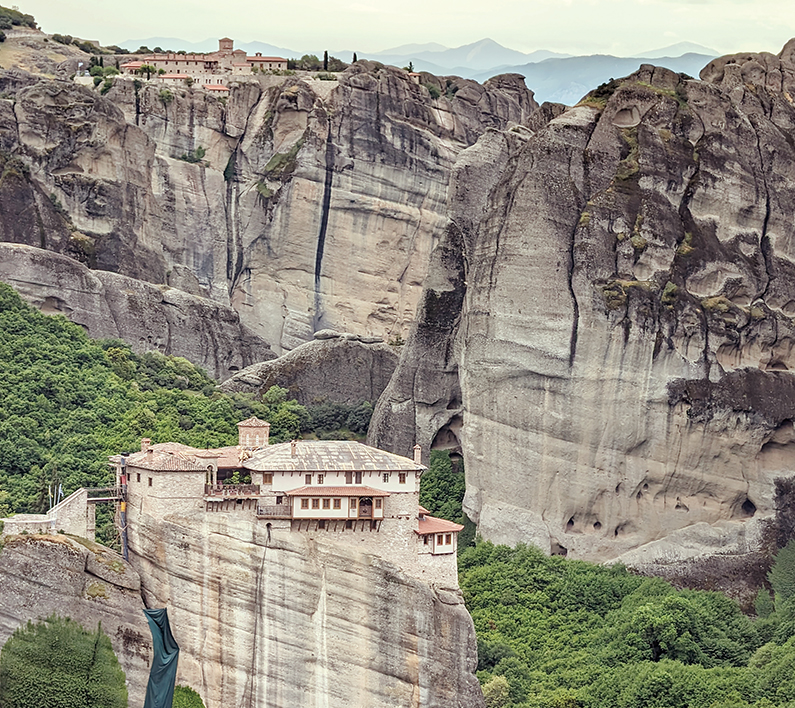
The next day brought the excitement of heading for Meteora (a UNESCO World Heritage Site); the landscape soon turned surreal as soaring columns of rock in wondrous forms marked the area. While the rugged formations are a destination for rock climbers, we headed to the summits by bus to experience the monasteries cut into the rock, the earliest going back to the 11th century AD. We visited three monasteries, mesmerised by their sanctity, their beautiful sacred art, isolation (especially in centuries past) and the devotion of nuns and monks who live here. In times past a man, enclosed in a net, would be lowered by a rope to procure supplies!
Swept away by the landscape and the beauty of Meteora we returned to Athens. Strolling through Plaka once again we browsed stores for souvenirs reminiscing the extraordinary heritage of Greece. We bought a print of an old lithograph of the Acropolis, a silent and stately sentinel, watching over a vast open land where the city stands today. Now framed at home, it is a precious memento of a very special country and trip.
