
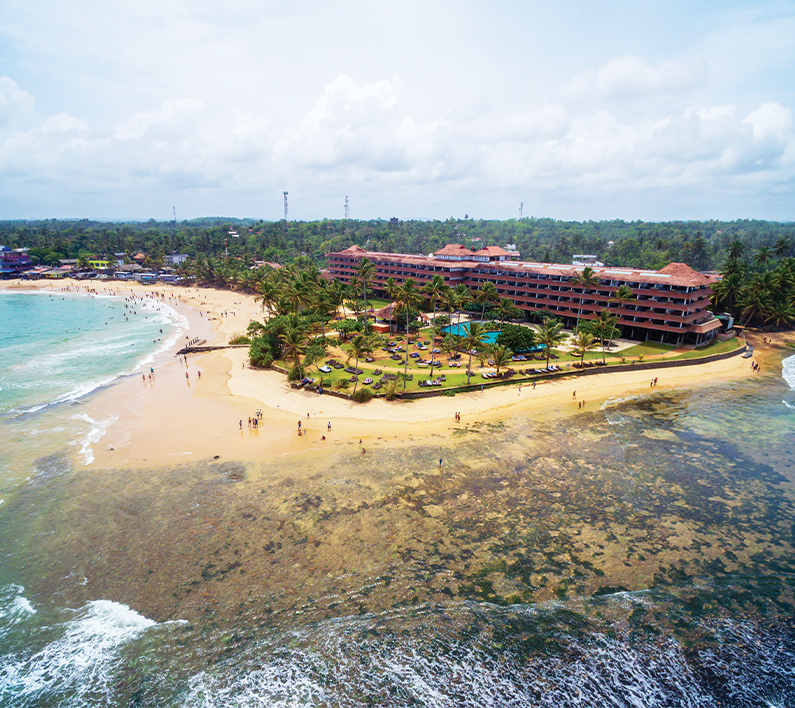
A road trip through part of the island nation of Sri Lanka offers travellers a spectrum of memorable experiences
BY BRINDA GILL | PHOTOGRAPHS: SATYAJIT S. GILL & OTHERS
Keen on a holiday at a destination within relatively comfortable travel time and effort, with a span of experiences, and one that would be without uncertainties or effort of getting a visa? Sri Lanka could be the answer to all that you wish for.
The day of travel arrived and we caught an early morning Indigo flight from Pune to Chennai and a comfortable ATR 72 connecting Indigo flight from Chennai to Jaffna (Northern Province). Soon enough the view outside the aircraft window unfolded an expanse of water, and as the aircraft descended the sight was soothed by stretches of greenery. Immigration was smooth, and Nusrath, the driver from Navigeto, was waiting for us; he would be with us throughout the trip.
We set off to see a few sights before checking into the Jetwing Jaffna. The weather was comfortably warm, the landscape and vegetation reminded us of Kerala and the temples of Tamil Nadu. We learnt a variety of fruits grow locally of which the karthagolamban mango is famous. We were soon by the lagoon, dotted with boats, and then walked through Jaffna Fort. Built by the Portuguese in 1618, it was extended by the Dutch in 1658; interestingly its walls were built with coral blocks that gave it a unique character.
The fort also has information on the area’s history and a store selling books. We went across to Jaffna Library (that has a beautiful harp or yazh with a note on its connect with the city), drove past Jaffna Stadium and the Clock Tower, before going to the hotel.
After a little rest, we stepped out at 4:30pm for Nallur Kandaswamy Kovil, a temple whose origins go back several centuries, dedicated to God Kartikeya worshipped in the form of the vel or divine spear, in time for the 5pm aarti. We returned to the lagoon area to take in the views, and then to the hotel for a beverage at the breezy rooftop Jaffna Sky Lounge with a view of the waters and city.
The next morning, after a good breakfast including hoppers and sambol, rasavalli kilangu kool (a sweet porridge made with purple yam) and bibikkan (a traditional Sri Lankan coconut cake), it was time to check out. We made a short visit to Jaffna Archaeological Museum where an enthusiastic young intern gave us an interesting insight into the exhibits that spoke of the rich history of the region.
The next destination was Trincomalee (Eastern Province), and we made our way at a leisurely pace, stopping at the War Hero Memorial at Elephant Pass (located at the gateway of the Jaffna Peninsula). A short while later we stopped at the Lake View Cafeteria that has a lovely view of the lake with birds, and half an hour later we were at Trincomalee Kanniya Hot Springs.
We then drove on to Trincomalee, and once at the town headed for the Fort Fredrick (built by the Portuguese in 1624 AD), and then the Thiru Koneswaram Temple, perfectly located by scenic waters, within the fort. It is believed that Lord Rama prayed here after the war with Ravana. Hundreds of cradles tied to trees spoke of the fervent prayers of couples who come here to pray for a child. Retracing the way, we went to Bhadrakali Amman temple, and happily reached Trinco Blue By Cinnamon, a lovely ocean-side resort.
Next day, we left for Polonnaruwa (North Central Province), the second capital of Sri Lanka (after the destruction of Anuradhapura in 993 AD). On the way we stopped at Kantale Dam. We were soon at Polonnarwa (a UNESCO World Heritage Site). We explored its monuments and monumental ruins spread over a vast area, and paid respects at the 10th century Chola temple where a priest was conducting rituals and at Gal Vihara.
As we then drove towards Anuradhapura, we spotted a few elephants in the area adjoining Minneriya National Park; we made a mental note to visit the park some summer during The Gathering when hundreds of elephants congregate at the lake to drink water. We were soon at Anuradhapura (a UNESCO World Heritage Site), the longest-serving ancient capital of Sri Lanka.
We visited the museum; imposing stupas that have relics of the Buddha – Jetavanaramaya stupa dated to the 3rd century CE, (the world’s largest stupa and considered to be the world’s largest brick structure by volume), Abhayagirha Stupa and Thuparama Stupa; the monastic baths and ponds; and marvelled at a beautifully carved Sandakada Pahana or Moonstone (a semi-circular slab at temple entrances that symbolise the Buddhist journey of life). Its beauty and symbolism made us wish to find a small moonstone souvenir. We later passed the vast Abhay Lake, dated to the 4th century it is Sri Lanka’s oldest manmade reservoir, and a little later are at Harbana Lodge By Cinnamon, at Harabana, a peaceful oasis, prettily lit, that looks most charming by night. Athreya, an Ayurveda centre offering traditional treatments set amidst greenery, is across the road from the resort.
We were up early the next day and at the reception area by 5:30 am as Nusrath suggested reaching Sigiriya (Central Province) early to start the climb up the formidable 5th century Lion Rock Fortress (a UNESCO World Heritage site) that has about 1,200 steps to the summit. The air was cool; the precinct charming with water bodies, gardens and paths through boulders; the ascent well-designed and the views panoramic as we climbed up. We spent a little while at the breezy summit amidst the ruins of a palace complex, returned via the gallery (along the path) that has exquisite old frescoes.
We then left for Dambulla Cave Temple (a UNESCO World Heritage Site) stopping at Gamini Gems (that has a collection of sapphire among other gems and a model mine) and Oak Ray Woodcarvings, a wood carving workshop-cum-store, both at Inamaluwa. Dambulla is regarded as the largest and best-preserved cave temple complex in Sri Lanka; its origins go back to the first century BC. Just when we thought we had climbed enough steps for the day we found another 350-plus steps lead the way to the exquisite cave temple complex. There are five caves, each exquisite and beautifully lit, replete with statues and paintings of the Buddha; they fill us with peace and admiration for the sheer devotion that led to their creation.
It was then time to head to a novel destination – Heritance Kandalama. For long we had read about the architecture of Sri Lankan architect Deshamanya Geoffrey Bawa (1919-2003), acclaimed for pioneering ‘tropical modernism’, that seamless meshes built structures with the natural environment of the site. The hotel’s architecture was awe-inspiring and we walked the length of level five, stretching by the mountain side, with rocks appearing in the structure, greenery an arm away as were troupes of monkeys.
The next day we headed for Yala National Park (Southern Province) that unfolded a long, scenic drive till we reached Cinnamon Wild Yala. The following day we enjoyed leisurely morning and bird-watching at the water body adjoining the resort. Around 2pm we walked to the parking area where Hasindu waited in a large 4x4 safari jeeps. After getting the entry tickets he drove us through the park for over three-and-a-half hours pointing out natural life. We were fortunate to spot several animals – monitor lizards, mongoose, black necked hare, sambar deer, spotted deer, wild water buffaloes, crocodiles, elephants and a leopard dashing across the road, as well as birds including pelicans, painted storks, peacocks, grey headed fish eagle, Malabar Pied Hornbill and hawk eagle.
We checked out the next morning, stopping for a little shopping at Kandygs at the Yala junction. Then taking the road for Hambantota (Southern Province) we drove through the town, visited the Magampura Ruhunu Heritage Museum (that offers an overview of the ancient Ruhuna Kingdom in the area), visited the Moonstone Mine of Beruwalage Gems & Jewellery at Meetiyagoda, and the Masks Museum at Ambalangoda.
We passed by the Puppet Museum at Balapitiya, the Madu Ganga River boat safari at Balapitiya and Kosgoda Sea Turtle Conservation Project, hoping to keep these and a tour of Brief Garden at Beruwala for another visit as we had to reach Lunuganga (Geoffrey Bawa’s country house) in time for the 3pm tour. A staff member showed us around the gorgeous property explaining how the site was patiently developed from a plantation into a country home over 40 years. After Geoffrey Bawa’s passing away, his ashes were laid to rest in a lawn, and only one small simple stone slab marks a spot that has some ashes, on which we place a tiny fragrant flower.
The Old Highway (Galle to Colombo) had a fair bit of traffic which we were unaccustomed by then. On reaching Colombo (Western Province) we headed straight to Galle Face Hotel, the iconic heritage hotel by the Indian Ocean and overlooking Galle Face, founded way back in 1864. We enjoyed views of the Indian Ocean, the call of the waves, a walk through the spacious, old-world hotel, and visited its museum that has photographs of famous personalities who have stayed at the hotel and other displays.
The next day was Sunday and we had to pack in a fair bit. After a leisurely breakfast overlooking the ocean, we stepped out – first for a little shopping at Laksaru for Sri Lankan souvenirs and then for a tour of Number 11, Geoffrey Bawa’s Colombo art-filled, aesthetic residence.
We then spent a couple of hours at Colombo National Museum taking in the breadth of artefacts and antiquities on display. Nusrath then drove through the main city showing us landmarks – the Town Hall, Nelum Pokuna Mahinda Rajpaksa Theatre, Independence Square beautiful Red Mosque, Plantation House, the Lotus Building, City of Dreams and other heritage and modern buildings.
Post a quick return to the hotel room to freshen up, we were left for dinner at the Ministry of Crab after which we happily made our way to the airport promising to return another day!
