
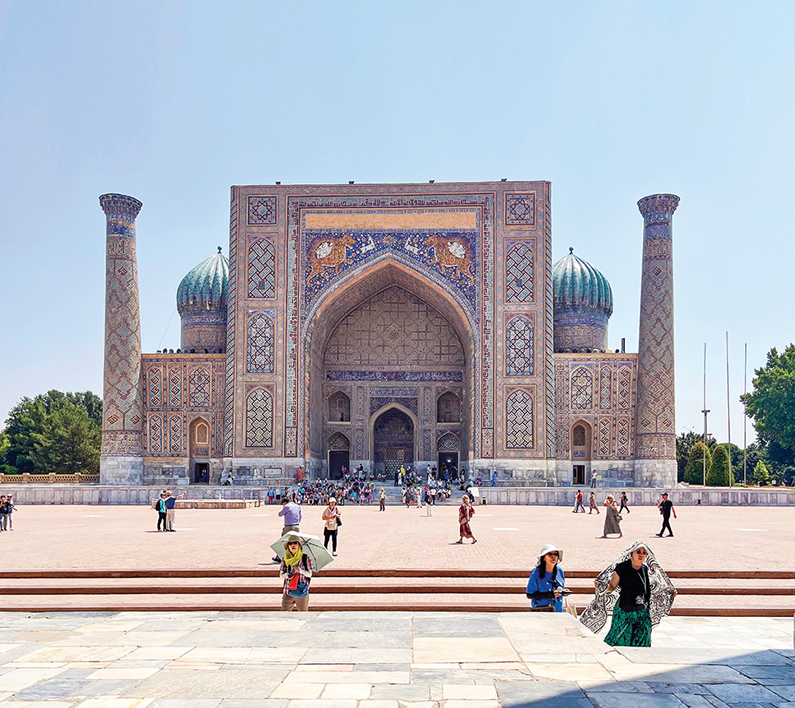
Uzbekistan’s beautiful blue-tiled monuments, colourful crafts and vibrant bazars are wooing travellers
BY BRINDA GILL | PHOTOGRAPHS: ADVANTOUR
The mention of the term Silk Road invariably evokes a charming image of men in flowing robes leading caravans of horses and camels carrying exquisite silks, precious stones, spices and other coveted goods. For centuries, if not millennia, the fabled Silk Road – not a single road but a vast web that stretched from China to Europe with arterial and feeder routes – witnessed the passage of good and people, culture and ideas. While these routes were in existence for centuries, the coining of the term Silk Road is credited to German geographer Ferdinand von Richthofen, who used it in 1877, and this usage in turn popularised it for time to come.
It is to experience the scent of the Silk Road, the 21st century traveller sets off to Central Asia long synonymous with the heart of the Silk Road. One of the most popular destinations in this region is Uzbekistan, a double land-locked country bounded by Afghanistan, Tajikistan, Kyrgyzstan, Kazakhstan and Turkmenistan, that has long been synonymous with preserving the allure of the Silk Road in its settlements, villages, towns and cities.
And a visit to the country – graced with sparkling blue-tiled monuments, colourful crafts and handmade textiles, vibrant bazaars with fresh produce and fresh breads, tasty food and, most of all, smiling and welcoming people – makes for a holiday of a lifetime.
The Uzbeks instantly connect with Indians for the country’s historical links with India (Termez, an important stop on the Silk Road is a Buddhist archaeological site and Babur, the Mughal ruler hailed from Fergana Valley); and their appreciation for Bollywood films and Hindi television serials is overwhelming.
The warm hospitality extended to visitors, Uzbekistan’s safe environment, its organised travel industry and Tashkent, the capital, being just three-hours away by flight from New Delhi, make travelling to the country easy and a pleasure. A trip to Uzbekistan typically commences with arrival at Tashkent that blends a modern cityscape with Soviet-era buildings and old monuments, and offers an ideal introduction to the country.
Being well-planned and spread out with avenues, fountains, parks, public spaces (especially Independence Square and Amir Timur Square) and a good transport system, make it comfortable to visit its sights.
One of the most prominent monuments of historical and religious importance is the Hazrati Imam complex that has mosques, madrasas, a mausoleum and institute. On display is Uthman Quran, a protected national treasure that is one of the oldest surviving Quran manuscripts and bears bloodstains believed to be of the third Caliph Uthman. Among the museums is the Museum of Applied Art located in the erstwhile residence of a Russian ambassador, a lovely complex with an array of craft and art exhibits, and a store with crafts.
An unusual yet popular destination in Tashkent are the spectacular underground metro stations, designed to showcase Uzbekistan’s history and culture expressed through murals, mosaics, portraits, striking light fixtures and chandeliers, making them akin art galleries! Then there is Chorsu Bazaar, a vast voluminous market covered with a large dome, filled with produce, products and the buzz of buyers and sellers, making it a fun place to shop and enjoy a local vibe. And there are charming restaurants and cafés serving traditional Uzbek food of which plov (pilaf), the national dish is fragrant, tasty and satiating.
From Tashkent one could fly west to Urgench, the airport closest to Khiva, and take a taxi to the town with an atmospheric living citadel in its heart. Khiva was once an important post for one of the main branches of the Silk Road – a strategic halting spot for caravans before they crossed/returned from the desert to their onward destinations. And a whiff of that heritage is experienced while strolling through the fortress built of thick sloping mud walls.
Stepping in through one of the gateways the paths lead past mosques, madrasas, mausoleums, minarets, palaces, museums, homes, restaurants as well as hotels located in heritage buildings. There are stores and informal sellers along the way, with an array of crafts, and one may meet artisans and weavers immersed in their craft and can purchase their work directly from there.
From Khiva one can travel southeast to Bukhara, a gem redolent with the artisans, bazaars, monuments, museums and a traditional hammam. Once a vibrant city on the Silk Road, home to scholars and Sufis, Bukhara charms the traveller with its compact city core with centuries-old market places. One can watch artisans and artists at work, and soak in the aura of medieval trading spaces, built at the intersections of roads, at the 16th century trading domes – Taki Zargaron (Dome of Jewellers), Tim Abdullah Khan (Dome of Fabric and Carpet Sellers), Taki Telpak-i-Furushon (Dome of the Headgear) and Taki Sarrafon (Dome of the Moneychangers).
A short walk from the domed arcades are stores selling a variety of striking handmade textiles from ikats to metal thread embroidered garments, miniature paintings, calligraphy, carpets and more. There are caravanserais that once warmly welcomed travellers and traders, some of which are now restaurants that welcome today’s travellers, and there are traditional courtyard homes where travellers can enjoy a local meal served in artistic pottery.
Bukhara has many monuments – the Poi Kalon ensemble with the Kalon mosque, the Kalon minaret and the Mir Arab madrasah; the Ark, an imposing fortress of thick sloping mud and brick walls, whose origins go back to the fifth century AD; the 18th century Bolo Hauz ensemble; the Nadir Divan-Beghi madrasah (built in 1622) whose portal bears sparkling blue tile work depicting phoenix in flight, Chor Minar; the Samanids tomb at the Samanids Recreation Park; and the mausoleum complex of the 14th century Sufi scholar Bahauddin Naqshband. And a short drive from the city centre is Sitorai Mokhi-Khosa, the lovely summer residence of the last Bukhara emirs.
From Bukhara one can enjoy a drive to Samarkand taking in the views of the landscape and making stops. At Gijduvan, about an hour from Bukhara, is the ceramic centre of the Narzullaev family, where a family member explains the pottery process, shows visitors the museum with a range of handmade pottery; one can buy pottery and enjoy a delicious Uzbek lunch here. A few hours later one is at Samarkand – a gorgeous breezy city with beautiful monuments and stores, blending its rich past with a growing modern city.
Samarkand’s spectacular monuments speak of its past – from the Registan complex with its sparkling blue-tiled madrasas with exquisitely adorned domes that look even more striking when illuminated at night to the impressive Bibi Khanum mosque, regarded as one of the largest and most glorious mosques in the world to the Gur-i-Amir, the mausoleum of Timur, whose architecture is said to have influenced later Uzbek and Mughal architecture to the Shah-i-Zinda necropolis where a path edged with blue-tiled mausoleum leads and creates a unique experience.
At monuments and neighbourhoods in the city one comes across embroidered textiles, silks and crafts. You can see handmade paper being produced from mulberry bark at The Meros Paper Mill located at the outskirts of the city.
After Samarkand one typically returns to Tashkent. Fergana Valley to the east is another destination that is attractive for its natural beauty and range of handmade crafts and textiles reiterating that one invariably returns from Uzbekistan with happy memories and bags filled with crafts!
